
The Donegal coastline is famous for it’s succession of glorious Atlantic beaches– from the endless sandy walking beaches to the small hidden coves and the wild exposed strands. Here are a few ideas for our favourite walking beaches – we can’t possibly list them all, just a few we particularly like. For guests looking to swim near Breac.House, you can swim at the two nearby Blue Flag beaches of Killahoey or Marble Hill – or at the small cove at Port na Blagh harbour.
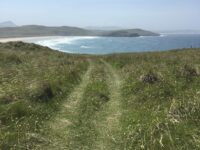
Of course, the one we like most is the one right on our doorstep – the spectacular Tramore. Only formed approx. 100 years ago after a succession of storms, it is a 2.5km long wide, white sandy beach which is often totally deserted. Part of the fun is also the walk to it from Breac.House– over sand dunes , grassy path and protected “machair” landscape – the suddenly the beautiful curved beach comes into view below you. The perfect spot to take our picnic backpack, sit on the sand and listen to the waves crash. You won’t want to leave, whatever the weather. Not suitable for swimming due to rip tides.
The small but perfectly formed cove of Lucky Shell, at the Ards peninsular nearby, is pretty special in a different way. Famed for its romantic setting, it is a popular engagement location if you are in the mood. Not suitable for swimming due to dangerous currrents.
To experience an almost wilderness, lunar landscape (reminiscent of The Skeleton Coast in Namibia for any of you who have been lucky enough to visit there) you must visit Magheraroarty beach – particularly the furthest extremities of the back strand. By walking the full loop of the Magheraroarty beach peninsula, we promise you will have the exposed far north east coast to yourself. Continue around the front / west beach and take in the amazing views to Inisboffin and Tory Island – and spot the increasingly popular surfers catching the particularly large waves which are created at this, the absolute most north westerly tip of the island of Ireland. The beach area nearest the harbour is safe to swim.
Made famous in recent years by Instagram and drone footage of this picture-postcard beach, there is a good reason why The Murder Hole at peninsula is so popular. Go there anytime to experience it’s beauty but it is particularly special at sunset – just remember there is a bit of a trot back to the carpark, which can be challenging in the dark !
If you are travelling to Ardara, perhaps to visit Eddie Doherty tweed, don’t miss Maghera beach and caves on the outskirts of the town. After a few minutes’ drive down a long, narrow road, passing the majestic Assaranca waterfall, you will find a small car park -from where it is a short walk to Maghera beach ad caves. If I could pick one place in Donegal to become an “ancient wonder of the world” it would be here. Try to time your visit so that it is low tide – meaning you can visit a number of the caves, just don’t linger in there as the tide can come in behind you very quickly. For geology fans, there is an amazing display of exposed quartzite rock – one of Donegal’s most popular rock types.
For the most perfect white sandy beach in Donegal (in our opinion!) visit Carrickfinn (which means fair coloured stone in Irish) and is a Blue Flag beach. If you are lucky, or time it right, you will see planes landing at the nearby airstrip – regularly voted one of the world’s most scenic airports. (If you happen to fly in or out of Donegal airport, don’t drive away without taking a walk on the beach). Also one of the most beautiful places to swim in Donegal. If you have time, you can walk the coastline at the end of Carrickfin, or drive, to the next beach. A place of some considerable history and mythology, it is called The Boat Strand in English but is Tra na Marbh in Irish, meaning the beach of the dead. You will see a small island in the bay, which is accessible at low tide, where bodies of unknown fishermen and unbaptised children were buried – an insight into the social history and harshness of Ireland’s past. You can visit but be prepared to be emotionally impacted.
More from Breac

Breac House wins Hideaway of the Year 2026
September 24 2026 in Features
Machair -ancient habitat, new life
August 18 2026 in News
The Aficionados Sunday Edit- Persons of Interest
April 5 2026 in Features

Play Donegal’s finest links golf courses
November 30 2025

Art, Architecture and Heritage - traditional to contemporary
November 30 2025